

30Apr
DAN 38 vs DANSE for Dentium Lab Needs
Based on the search results, the DAN 38 and DANSE are both dental implant analogs produced by Dentium, but they serve different purposes and specifications. Here’s a breakdown to clarify their roles in the context of Dentium lab requirements:
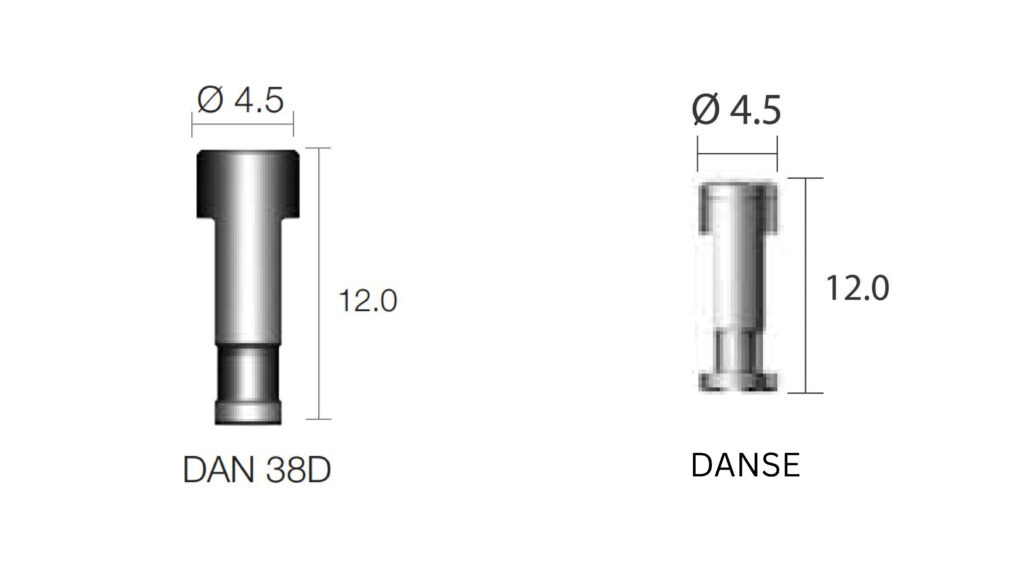
1. DAN 38 Laboratory Analog
- Purpose: The DAN 38 is explicitly labeled as a laboratory analog (DAN 38) in Dentium’s catalog. It is designed for use in creating physical or digital models for prosthetics and implant planning.
- Application: Likely used for standard workflows requiring compatibility with Dentium’s implant systems, such as model duplication, abutment design, or prosthesis fabrication in dental laboratories.
- Key Features: While specific dimensions are not detailed in the search results, it is categorized under (surgery) and ” Dentium,” indicating its role in surgical planning and lab procedures.
2. DANSE Implant Analog
- Purpose: The DANSE is a stainless steel dental implant analog with a focus on biomechanical stability and precision.
- Specifications:
- Material: Stainless steel.
- Dimensions: 4.5 mm diameter and 12 mm length.
- Design: Features a tapered conical hex connection for hermetic sealing and load distribution, minimizing bone loss.
- Compatibility: Works with Dentium’s SuperLine implant system and supports dual/combi abutments, angled abutments, and direct-casting workflows.
- Application: Ideal for advanced cases requiring precise load distribution, such as single-tooth restorations, bridgework, or scenarios with non-ideal angulation or inter-arch space.
Key Considerations for Lab Requirements
- Workflow Compatibility:
- DAN 38: Suitable for general laboratory workflows, including digital model creation and physical prototyping.
- DANSE: Better for complex cases requiring biomechanical precision (e.g., custom abutments, bridgework) and compatibility with Dentium’s SuperLine system 59.
- Material and Durability:
- DANSE’s stainless steel construction ensures long-term stability, whereas DAN 38’s material is not explicitly stated but is likely optimized for lab use 15.
- Clinical vs. Lab Use:
- DANSE is often used in clinical settings for direct-casting or angled abutments, while DAN 38 appears tailored for laboratory modeling 59.
Recommendation
- For digital analogs in printed models, the DANSE is recommended if the workflow involves Dentium’s SuperLine system or requires biomechanical precision.
- The DAN 38 is more appropriate for standard laboratory modeling, especially if compatibility with other Dentium systems (e.g., Implantium) is required.
For definitive guidance, consult Dentium’s official lab manuals or contact their technical support to confirm compatibility with your specific implant system and digital workflow.

Leave a Reply